How One of the Most Devout Students of Scripture Became One of Its Greatest Teachers
by Scott Hahn
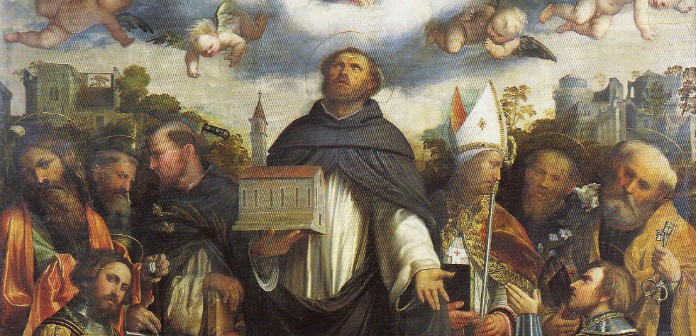 When I was a sophomore at Grove City College, years before any of my theological conversions, I underwent a radical transformation in my understanding of philosophy. Perusing the college library, I’d found some books by a man named Aquinas, which I took home, devoured, and immediately began expounding to my friends. They, evangelicals all, were shocked and urged me to flee this temptation. “How can anyone be a ‘Thomist Calvinist’?”
Yet I’d never read anyone like Saint Thomas—such a clear, penetrating, and deep thinker. And so I began a lifelong commitment to understanding this saint, who was not only a genius, but a man who contemplated truth and opened his soul to being, with a radical openness that I had never encountered in any teacher.
How did he get that way? I propose that Saint Thomas is best understood not simply by looking at his metaphysics, or by studying his appropriation of Aristotle, or by updating him with modern science. Rather, I suggest that Saint Thomas is fundamentally a biblical theologian. In fact, many of his biographers tell us that Thomas would have described himself primarily as a teacher of Scripture.
One of Thomas’s earliest biographers, the Dominican Bernard Gui, has written (during Thomas’s canonization process, c. 1318): “His knowledge was like an overflowing river of scriptural doctrine, sprung from the fount of Wisdom on high and then branching out through all the variety of his writings.”1
Many scholars now are rediscovering the biblical depth of his teachings, and the importance of appropriating the scriptural categories that formed the framework of much of his thought. Today he is recognized by many as one of the greatest biblical theologians in history.
We need, each and all, to return to the books that Thomas studied and venerated.
Where does all this begin for the Catholic who wants to understand the Scriptures and evangelize? It begins for you and me where it began for Saint Thomas Aquinas. We begin as he did, on our knees, with Bible in hand.
Praising the habits of our hero, Bernard Gui writes:
When I was a sophomore at Grove City College, years before any of my theological conversions, I underwent a radical transformation in my understanding of philosophy. Perusing the college library, I’d found some books by a man named Aquinas, which I took home, devoured, and immediately began expounding to my friends. They, evangelicals all, were shocked and urged me to flee this temptation. “How can anyone be a ‘Thomist Calvinist’?”
Yet I’d never read anyone like Saint Thomas—such a clear, penetrating, and deep thinker. And so I began a lifelong commitment to understanding this saint, who was not only a genius, but a man who contemplated truth and opened his soul to being, with a radical openness that I had never encountered in any teacher.
How did he get that way? I propose that Saint Thomas is best understood not simply by looking at his metaphysics, or by studying his appropriation of Aristotle, or by updating him with modern science. Rather, I suggest that Saint Thomas is fundamentally a biblical theologian. In fact, many of his biographers tell us that Thomas would have described himself primarily as a teacher of Scripture.
One of Thomas’s earliest biographers, the Dominican Bernard Gui, has written (during Thomas’s canonization process, c. 1318): “His knowledge was like an overflowing river of scriptural doctrine, sprung from the fount of Wisdom on high and then branching out through all the variety of his writings.”1
Many scholars now are rediscovering the biblical depth of his teachings, and the importance of appropriating the scriptural categories that formed the framework of much of his thought. Today he is recognized by many as one of the greatest biblical theologians in history.
We need, each and all, to return to the books that Thomas studied and venerated.
Where does all this begin for the Catholic who wants to understand the Scriptures and evangelize? It begins for you and me where it began for Saint Thomas Aquinas. We begin as he did, on our knees, with Bible in hand.
Praising the habits of our hero, Bernard Gui writes:
O wondrous mystery of Providence, that at first God conceals the meaning of His Scripture and then at last reveals it, in order to show how far short of His mysteries comes human understanding and that whoever desires the least insight into them must have recourse to Him who chose to reveal His secrets to the Prophets and the Apostles! O happy soul whose prayer was heard by God in His mercy, who thus teaches us, by this example, to possess our questioning souls in patience, so that in the study of divine things we rely chiefly on the power of prayer!6[hr]